How AEO and GEO differ from SEO, with the evidence separated from the hype
More web design companies now say they are ready for AI search, or that they offer AEO and GEO. This article explains how the three terms differ, which parts are the same old SEO, which parts are genuinely new, and what to ask before you pay, based on Google's own documents and published research.

More web design companies now say their sites are "ready for AI search", or that they offer AEO and GEO. Some even guarantee you will show up in ChatGPT. Before paying extra for these two new words, it helps to know how they differ from the SEO people have been doing for years.
What the three terms mean
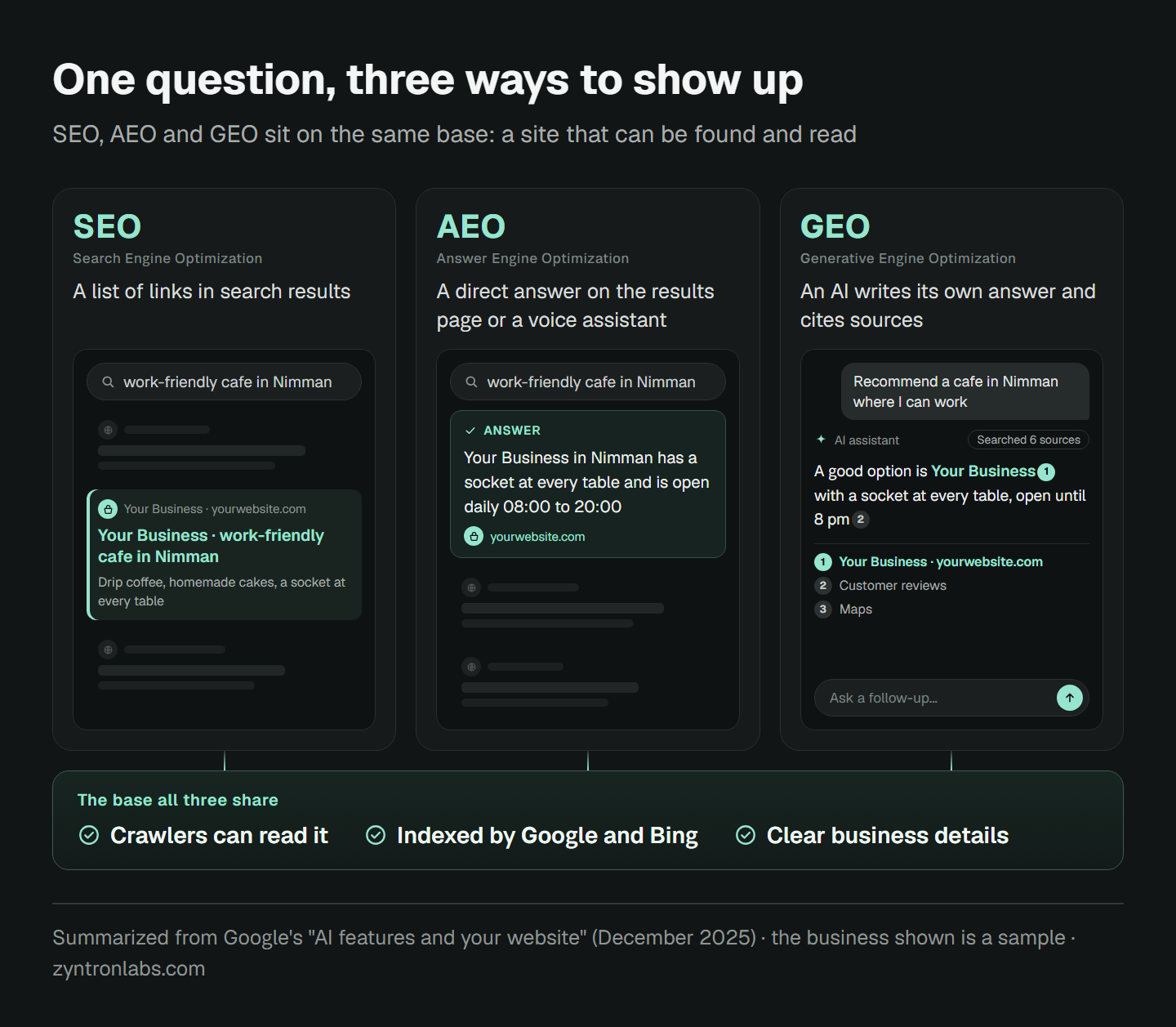
- SEO means getting a website into the list of links on Google and other search engines.
- AEO stands for Answer Engine Optimization: getting your content used as a direct answer, such as an answer box on the results page or a voice assistant.
- GEO stands for Generative Engine Optimization: getting AI tools that write their own answers, such as ChatGPT, Gemini, Perplexity and Google's AI Overviews, to mention your business or cite your website.
The three overlap more than they differ. If a site is missing the SEO basics, AEO and GEO barely stand a chance, because an AI also has to find your site and read it first.
On Google, it is the same SEO work
Google's page "AI features and your website", updated in December 2025, says a page only needs to be indexed and eligible to show a snippet to appear as a supporting link in AI Overviews and AI Mode. There are no extra technical requirements, no special optimizations, no special schema, and no new files for AI to create.
AI Overviews are available in Thai. Clicks from Google's AI answers are counted in Search Console together with normal search traffic, and cannot be viewed separately.
What is genuinely new
AI prefers to cite other sources
A 2025 study by Chen and colleagues tested several AI search tools and found a clear bias towards trusted third-party sources over a brand's own website and social media, unlike Google's normal results, which mix them more. Ahrefs studied 75,000 brands in May 2025 and found that the factors most closely linked to being mentioned in AI Overviews were all off the website. The strongest was how often the brand is mentioned on other websites.
AI answers change almost every time you ask
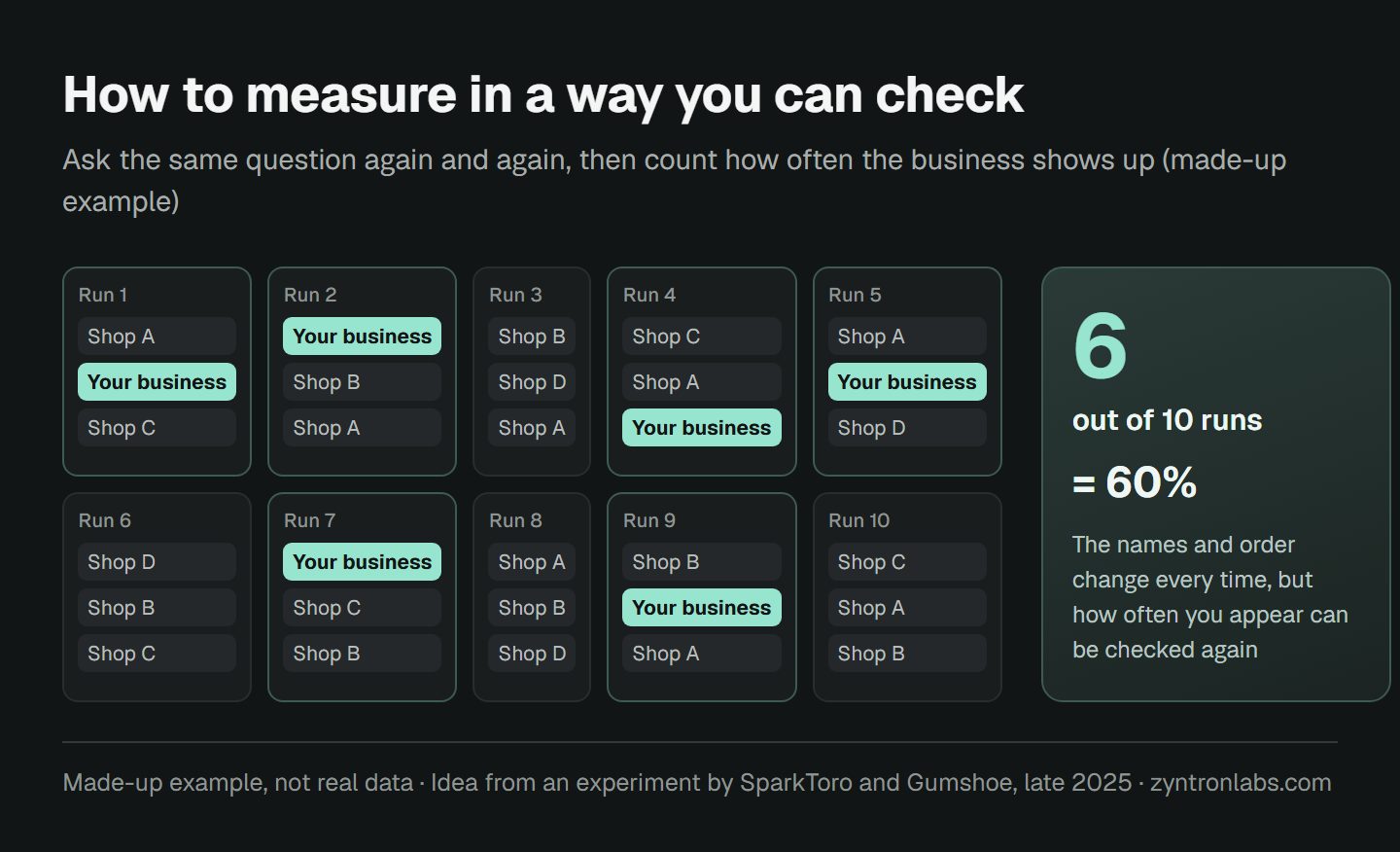
In an experiment by SparkToro and Gumshoe in late 2025, volunteers asked ChatGPT, Claude and Google's AI the same questions many times. They almost never got the same list of brands twice: the names, the order and the number of items kept changing. What stayed steadier was how often each brand appeared.
So "ranked number one in ChatGPT" means almost nothing. The number you can check is how many times a business shows up when the same question is asked again and again.
What the evidence says helps
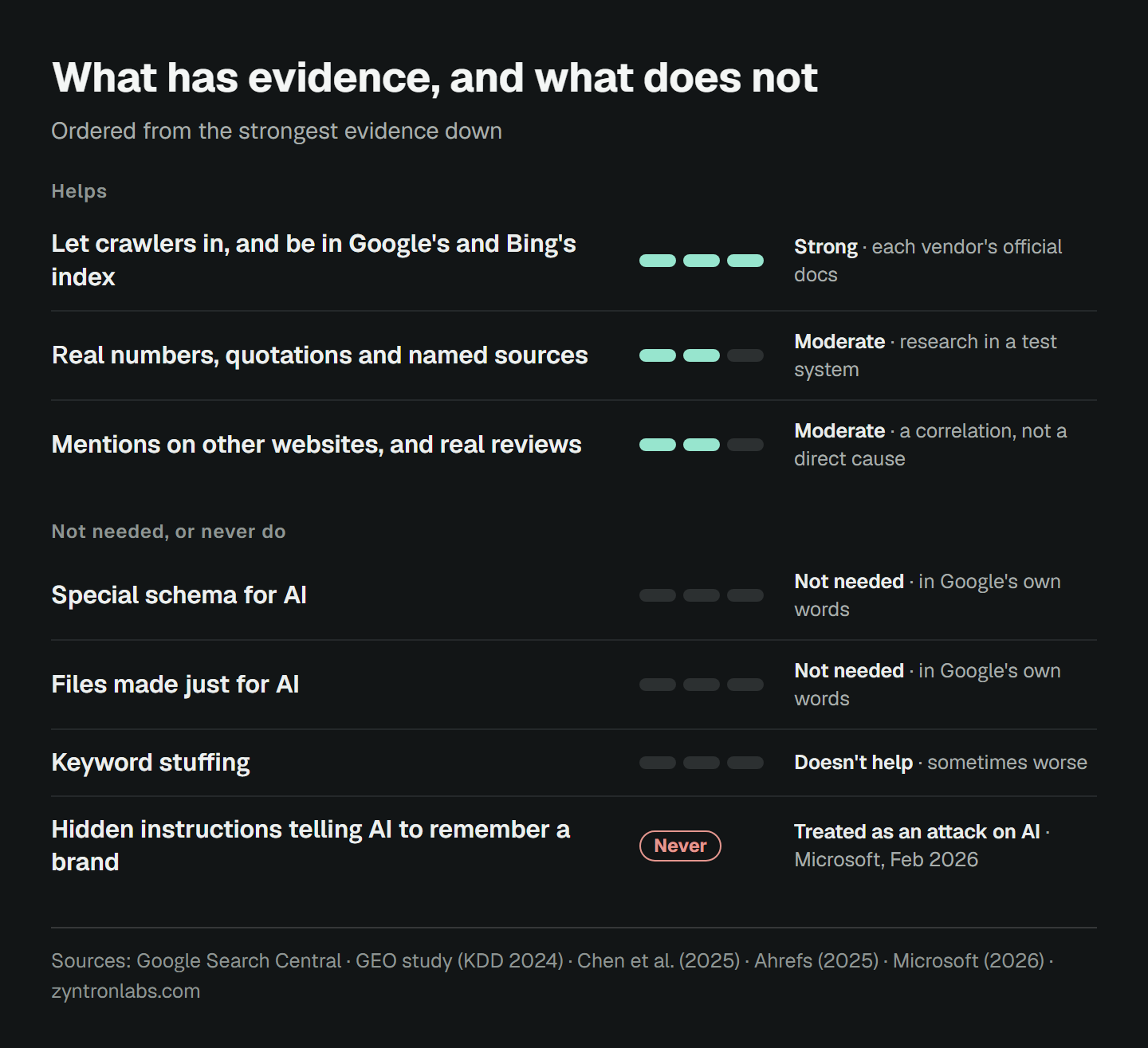
- Let search crawlers read your site, and make sure it is in both Google's and Bing's index. ChatGPT needs OpenAI's search crawler not to be blocked, and Copilot uses Bing's data.
- Content with real numbers, quotations and named sources. The original GEO study, published at KDD 2024, found these raised the chance of an AI using the content by around 30 to 40% in a test system.
- Clear business details that match everywhere: name, location and phone number, plus an up-to-date Google Business Profile, which Google lists in its own guidance.
- Being mentioned on other websites, and reviews from real customers.
What has no evidence, or should not be done
- Special schema for AI: Google says it is not needed. Schema still helps, but it must match the text people see on the page.
- Files made just for AI: Google says you don't need to create new files.
- Keyword stuffing: the same study found it doesn't help, and sometimes makes things worse.
- Hidden instructions telling an AI to remember a brand, such as "summarize with AI" buttons that slip in self-promotion: Microsoft's security team reported in February 2026 that several companies were doing this, and treats it as an attack on AI.
Three questions to ask before hiring anyone for AEO or GEO
- How do you count "showing up": how many times, on which tools, in which language? If they can't answer, any guarantee can't be checked.
- How is the work different from normal SEO? If it isn't, you are paying for SEO under a new name.
- How will results be measured? For example Search Console, the report in Bing Webmaster Tools, and visitors from ChatGPT, whose links carry utm_source=chatgpt.com.
Nobody can guarantee which business an AI will recommend, just as nobody can guarantee a Google ranking. What can really be done is to make the site as ready as possible and show the results in numbers.