How much does a website cost? Why two quotes can be ten times apart
The number on a quote is not the price of a website. It is the price of what that provider chose to put in. This article shows the six lines you need to find before you sign, and how adding up five years of costs can turn the cheapest offer in year one into the most expensive.

Business owners about to get a website usually do the same thing. They ask three providers and get numbers back like these: about $210, $1,048 and $4,491, even though they described the same job word for word.
Most people decide at this point that the expensive one is overcharging. Sometimes that is true. More often, the three quotes were never offering the same thing in the first place.
This article won't tell you how much you should pay, because I don't know your project. It will show you how to read quotes so you can really compare them, and which numbers sellers often leave out.
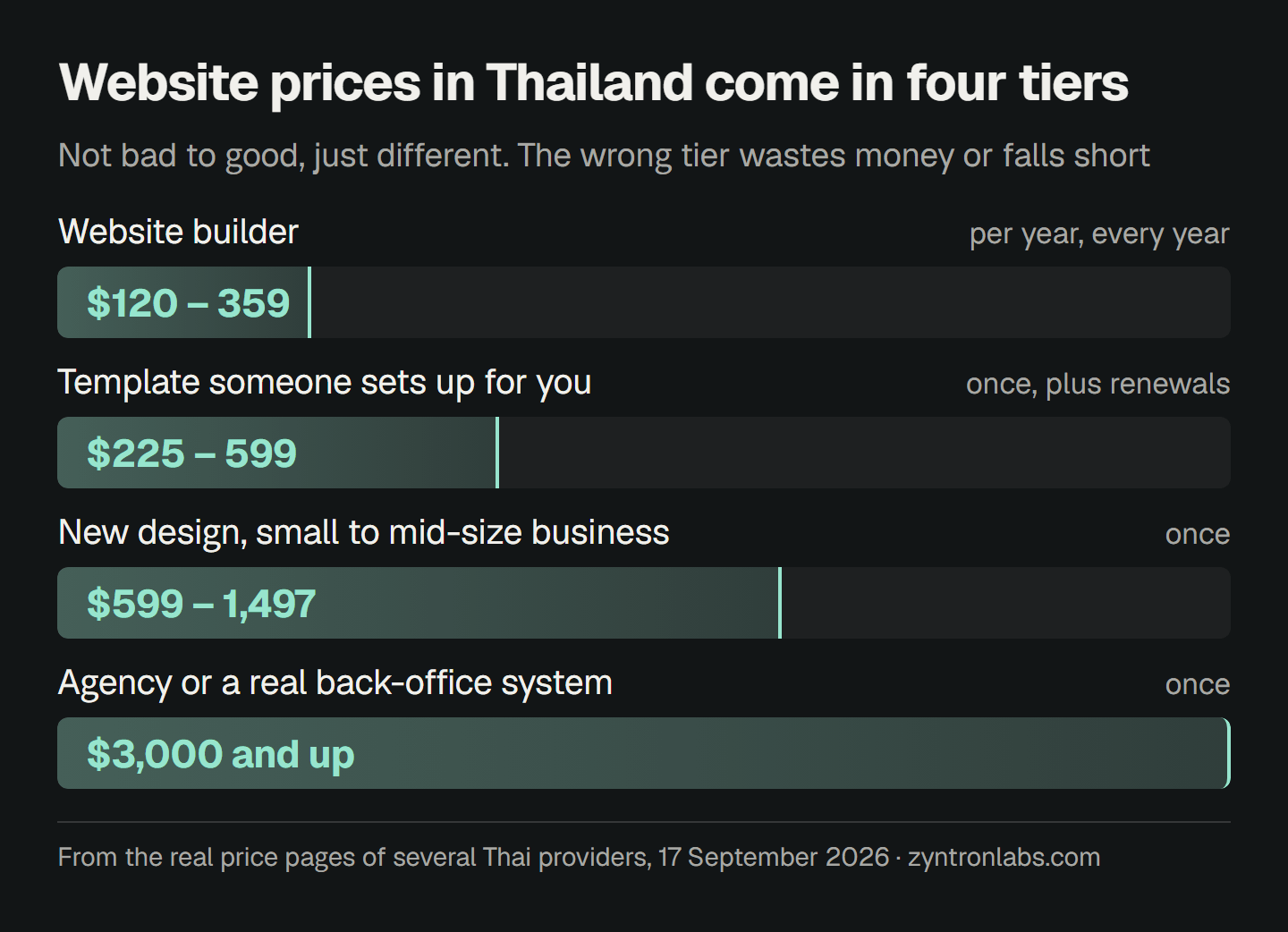
Prices in the Thai market today fall into four tiers
I took the ranges below from the price pages of several Thai providers on the day I wrote this, not from a gut feeling. I don't name them because their prices change all the time. The amounts are converted from baht at 33.4 baht to the dollar.
- A website builder you pay for every year: about $120 to $359 a year. You drag and drop it yourself, no developer needed.
- A template that someone sets up and fills with your content: about $225 to $599, paid once up front, with a separate yearly renewal fee.
- A new design for a small to medium business: about $599 to $1,497.
- A full agency, or a site with a real back-office system: from about $3,000 up.
These four tiers do not run from bad to good. They are different things. A shop that needs one page so people can find it and tap to call pays far too much if it buys tier three. A company that needs a booking system that updates stock gets something it can't use if it buys tier one.
Six lines to find in a quote
One: what do you pay in year two?
Almost every Thai quote says free hosting for 1 year, free domain for 1 year, free SSL. The words to read are 1 year, not free.
When I looked through real price pages, one provider clearly stated a renewal fee of about $90 to $135 a year, which is very honest. Many others didn't put this number anywhere on their price page.
Always ask for a number before you sign: from year two on, what do I pay, and how much is it a year in total? If they can't answer right away, or need to go and check first, that is already half your answer.
Two: how many rounds of changes?
A real example I found: one provider had two packages at about $599 and $898. Almost everything in them was the same. The clearest difference was that the cheaper one allowed 4 rounds of changes, and the more expensive one allowed unlimited changes until handover.
That $299 difference is the price of not having to argue at round five about whether this round counts as a change or as doing what was agreed in the first place. Anyone who has been through a design project knows that $299 can be very cheap.
Three: who owns the website?
A website builder is a rental. The day you stop paying the yearly fee, the site is gone, and you can't move it anywhere else because the design you set up is tied to their system. A site you pay someone to build is your own files. You can move hosts and change who looks after it.
That doesn't make renting bad. For a shop that wants a website this week and doesn't want to touch anything technical, renting really is the right answer. The point is to know you are renting, not to think you bought it outright and find out when you want to move.
Four: how many pages, and how are extra pages charged?
The most common package is 10 pages. That sounds like a lot until you count: home, about us, contact, articles, and one page for each service. A business with 12 services is over the limit before the work even starts.
Ask what each extra page costs, and ask before you sign. A price for extra pages halfway through the project is a price you have no power left to negotiate.
Five: who writes the content?
This one slows projects down the most, and almost nobody writes it in the quote. In almost every quote, website design means they build the boxes. The text and pictures that go in the boxes are yours to find.
Most websites that sit stuck for months are not stuck because the developer is slow. They are waiting for content from the owner. If you know from day one that it is your job, you can set time aside to write it, or pay someone for it knowing the price in advance.
Six: the free extras, and what they would cost if they weren't free
Free SSL, 100 free backlinks, one free SEO keyword. These make a quote look like better value straight away, while the seller's costs barely move. SSL really is free to get today and takes a few minutes to install. And a bundle of a hundred backlinks like that does not help your ranking the way the name suggests.
Some extras do have real value, such as training until you can do it yourself, or a one-year promise to fix bugs. Telling them apart is easy. Ask: if you leave this out, how much lower is the price? If the answer is that it wouldn't be lower, that extra never had a price to begin with.
A comparison that works: add up five years
Take the starting price, add the yearly costs times four, then compare. The numbers below are a made-up example to show the method, not anyone's prices.
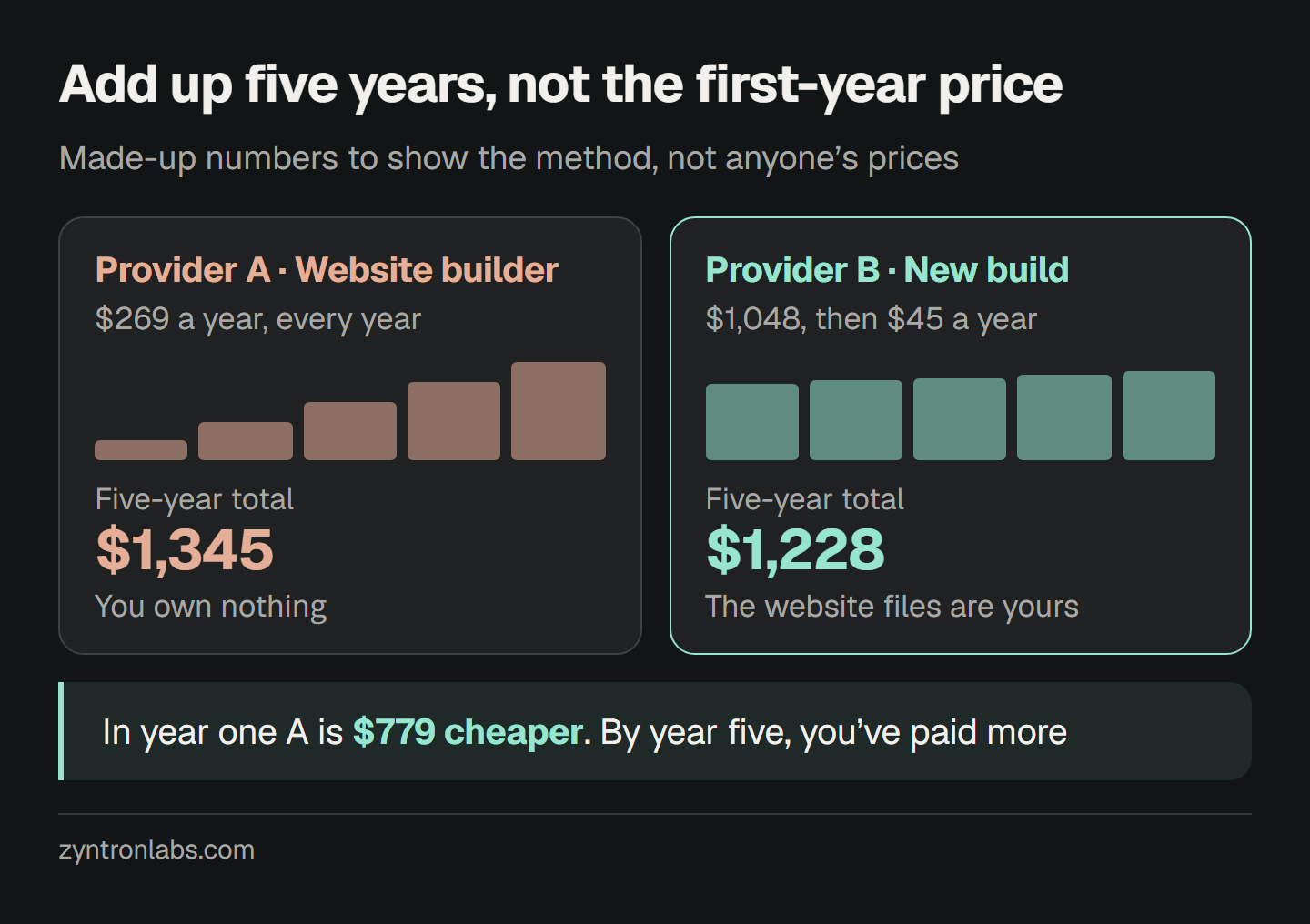
In year one, provider A is $779 cheaper than provider B, and that number makes people decide on the spot without thinking further. By year five, A has cost more, and what you hold in your hands is completely different.
Five years is not a magic number. I use it because it is about how long most websites last before they get rebuilt. If your business changes fast and you know you will rebuild next year anyway, renting really is better value. Work it out over the time you will actually use it, not the time I assumed.
If your budget is really tight, what to cut first
- Cut the number of pages first. Start with the three or four pages that actually sell, and add more later.
- Cut the new design. Use a template that is already good and change the colours and pictures to make it yours.
- Cut features no customer has asked for yet. Member accounts and loyalty points are in this group almost every time.
- Don't cut page speed, don't cut how the site works on phones, and don't cut backups.
The one people cut most often is mobile, because the site looks fine when they check it on a computer, even though most people in Thailand visit websites on their phones. When you check the work, always open it on your own phone first, then on a computer.
Five questions you can ask by chat today
- From year two on, what do I pay, and how much is it a year in total?
- How many rounds of changes do I get, and how do you decide what counts as a change?
- How much is each page beyond the package?
- Who finds the text and pictures?
- If one day I want someone else to look after it, what do I get to take with me?
These five are very hard to answer if the seller plans to make the price look cheap now and collect the rest later. They are very easy to answer if the price was honest from the start. So the answers tell you more about the person you are about to hire than the number on the quote does.
Summary
Prices ten times apart do not mean someone is cheating. Usually it means you are comparing different tiers. Compare the five-year total, not the first-year price. Find the six lines above before you sign. And ask those five questions while you haven't paid anything yet.
The most expensive website is not the one with the highest price. It is the one that is finished but doesn't work, so you have to pay for a whole new one eight months later.