Once you have a website, what else do you pay for? Real numbers for every item
The question that always comes after agreeing on a price is: and how much a month after that? This article gives real numbers for every item: domain, hosting, email, LINE OA and payment fees. It also explains why the cost people don't fear is the one that eats the most money.

Once the price for the website is agreed, the next question is almost always: and how much do I pay every month after that? The worst answer you can hear is: oh, not much.
This article gives the real number for every item. I took every figure below from the provider's own price page on the day I wrote this, not from memory. They are Thai prices, converted from baht at 33.4 baht to the dollar, and they can change. Use them to get a sense of size, not as a quote.
First, split your costs into two kinds. The first is fixed costs: you pay the same every month whether you sell anything or not. The second is variable costs: a percentage of the money that comes in. Most people fear the first kind because it arrives as a bill. But the second kind eats more money almost every time.
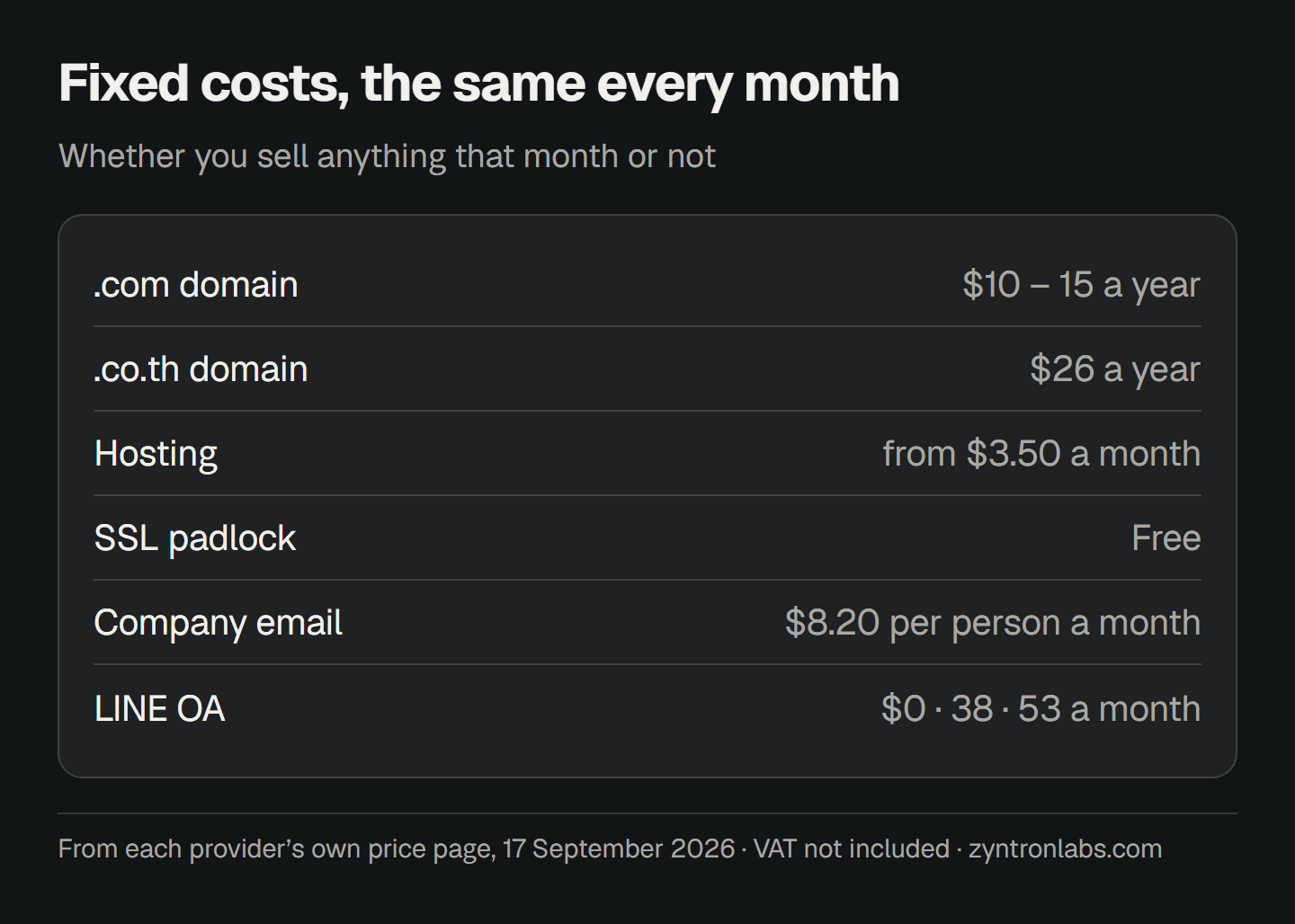
Fixed costs: what you pay every year for sure
Domain
A .com name costs about $10 to $15 a year, depending on the provider. For .co.th, the official price from the Thai domain registry is about $26 a year including VAT, and the provider that registers it for you may add a handling fee on top.
Registering a .co.th needs your business registration papers, which is both good and bad. The good part: Thai customers see it and know you are a real registered company. The bad part: if your business isn't registered yet, you can't get one, and it costs more than twice as much. A shop that is just starting can use .com first and add .co.th later.
Hosting
Shared hosting in Thailand starts at about $3.50 a month. Hosting built just for WordPress is around $45 a year. And for a site that needs no server processing at all, such as a site that presents your services with no back office, there are hosts today that are genuinely free.
The price of hosting is not what decides whether a site is fast or slow. Most slow sites are slow because the images uploaded to them are far bigger than they need to be and there are more plugins installed than anyone uses, not because the hosting is cheap. Moving to pricier hosting without fixing those two things first usually means paying more and getting no faster.
The padlock (SSL)
Free, and it should be free. These days the certificate can be issued automatically at no cost, and almost every host sets it up for you. If a quote charges you a yearly fee for the padlock, ask what kind of certificate it is and why you have to pay.
Email with your company name
The Thai price of the Google Workspace starter plan is about $8.20 per person per month at full price. Right now there is a first-year discount to about $4.10 for the first 20 users, which means the price doubles in the second year. Budget from the full price.
A one-person shop doesn't need to pay for this from day one. Email forwarding into your existing inbox usually comes with your hosting and works fine. Move to the real thing when you have staff who each need their own inbox.
LINE OA
This is the cost that grows fastest, and nobody warns you about it. LINE OA is a business account on LINE, the chat app most people in Thailand use. The free tier sends 300 messages a month. The Basic plan is about $38 a month for 15,000 messages, with extra messages at about 0.30 US cents each. The Pro plan is about $53 a month for 35,000 messages, with extra messages at about 0.18 cents each. None of this includes VAT.
What shocks people when the bill arrives is how messages are counted. LINE counts the number of people who receive a message, not the number of times you press send. A shop with 5,000 followers that sends news three times a month uses 15,000 messages. That fills the Basic plan's quota exactly, even though it feels like only three sends.
Variable costs: what grows with your sales
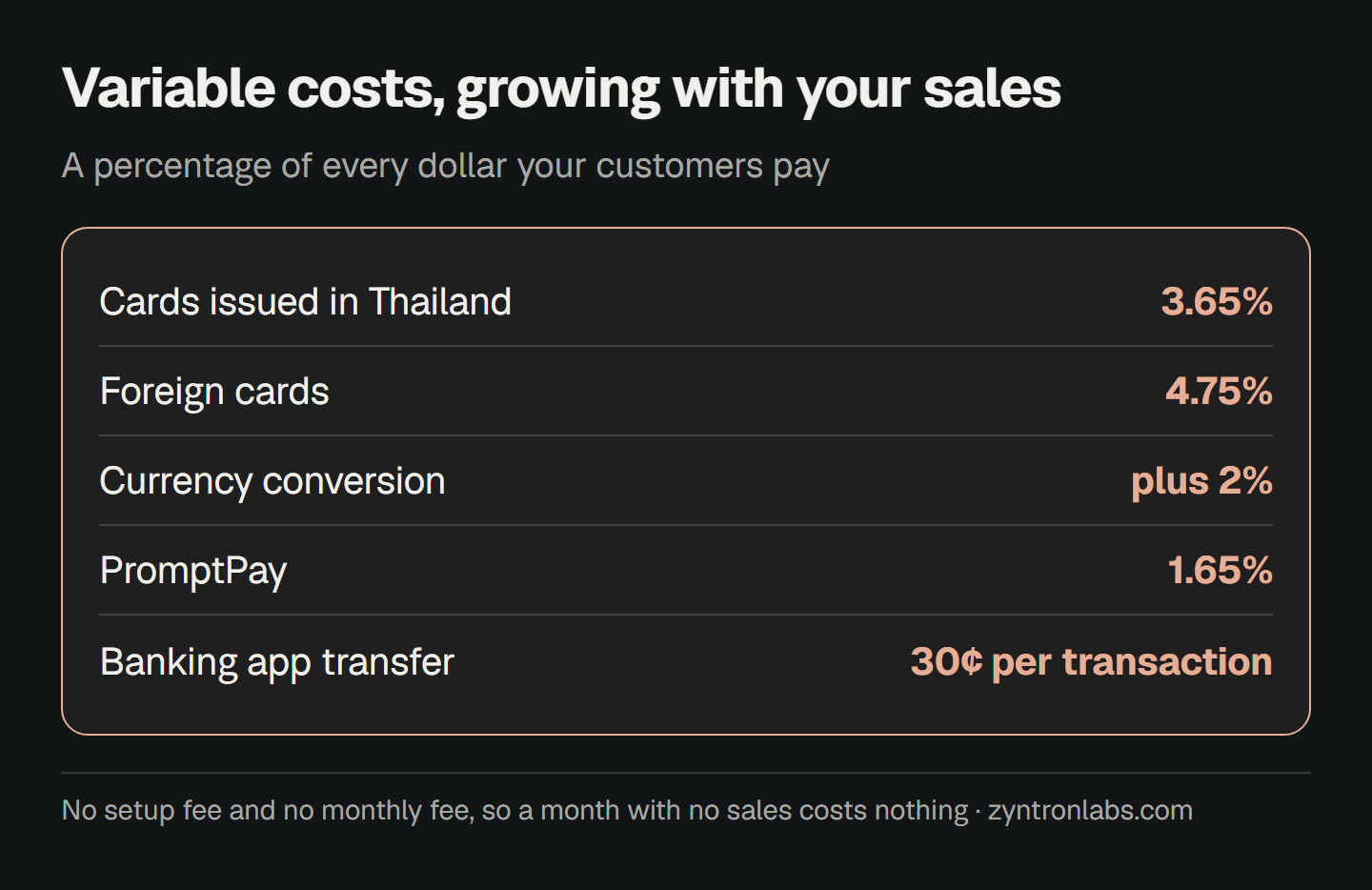
If your website takes payments, the payment provider takes a fee from every payment a customer makes. These are the rates in Thailand right now.
- Credit and debit cards issued in Thailand: about 3.65 percent per transaction. Some providers add a fixed fee of about 30 cents.
- Cards issued abroad: about 4.75 percent, plus another 2 percent if the currency has to be converted.
- PromptPay, Thailand's QR code bank transfer: about 1.65 percent per transaction, the cheapest of the methods you can really accept.
- Transfers made directly in a banking app: some providers charge about 30 cents per transaction, not a percentage.
- Paying the money out to your bank account: about 60 cents each time. And when a customer claims money back through their card, there is a handling fee of a few dollars, up to about $15, per case.
The good news: the big providers in Thailand have no setup fee and no monthly fee. In a month with no sales, you pay them nothing at all. Fees only happen when money actually comes in.
Why this cost is much bigger than you think
Try the numbers for a shop that sells about $3,000 a month.
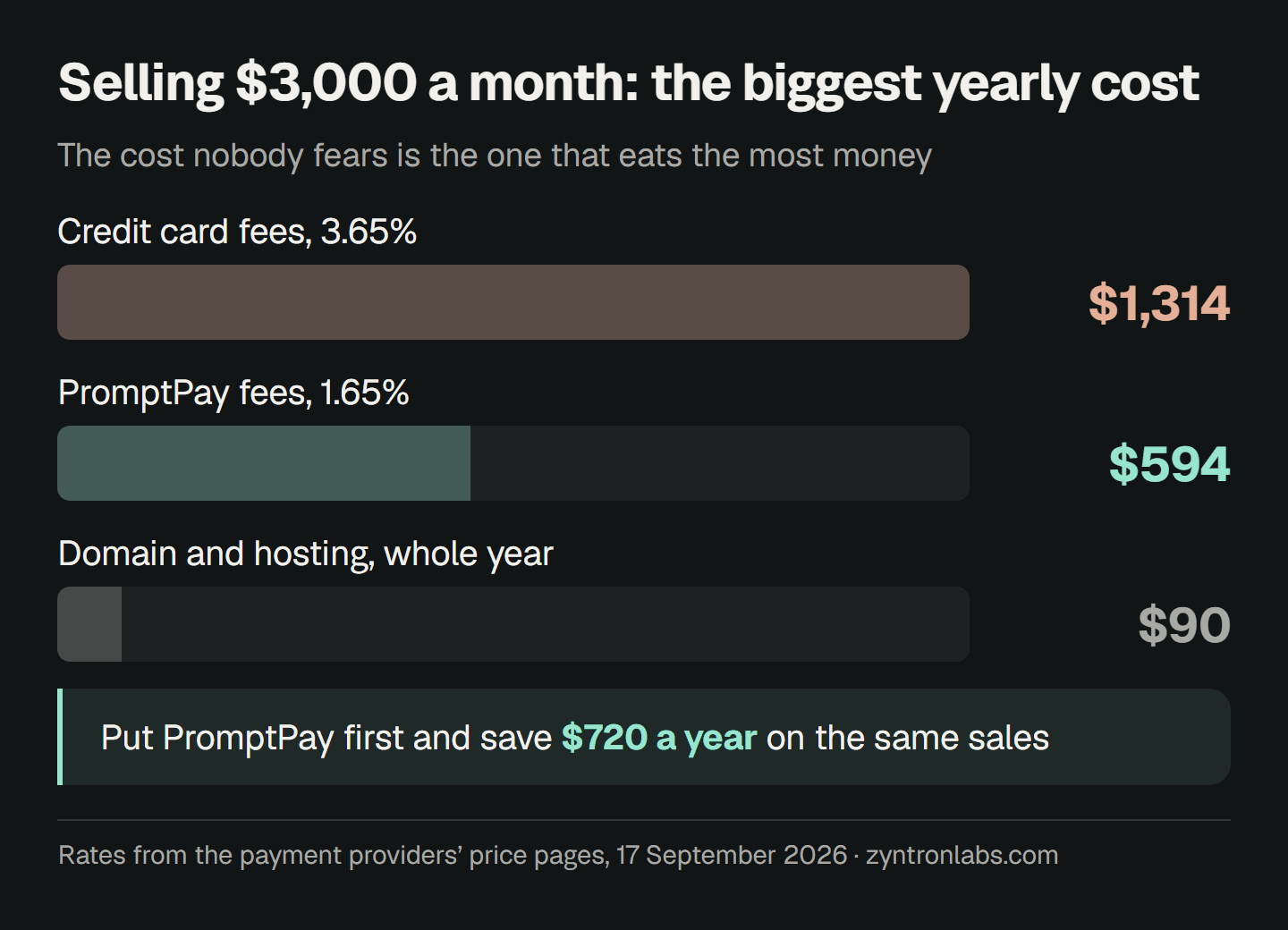
This shop's domain and hosting together may come to less than $90 for the whole year, but payment fees take more than $1,300. That is why I said at the start that the cost people don't fear is the one that eats the most money.
The way to cut this that really works is to make PromptPay the first option customers see on the payment page, not hide it at the bottom. Many Thai customers are happy to pay by PromptPay if they see it first. Keep cards, though, because foreign customers and people buying expensive items tend to choose a card.
Care fees: the cost to ask about most clearly
A monthly care fee is not the hosting fee, and it is not the domain fee. It pays for a person who keeps doing what the site needs but nobody sees. The problem is that the word care means nothing without a list after it. Ask what it covers.
- Updating the system and plugins when a security hole is announced, not waiting until the site breaks.
- Automatic backups, stored somewhere other than the site itself, and restored for real at least once.
- Watching whether the site is down, so you are not the one who has to find out.
- How many hours a month of small content edits are included, and how anything beyond that is charged.
If your web developer charges you one monthly lump sum, ask them to split it so you can see which part they pass on to third parties, such as hosting and the domain, and which part is their own labour. If they can't or won't split it, you will never know what you are paying for, and you won't be able to compare them with anyone else.
So what does it all add up to?
It depends on what kind of site you have. The two cases below are examples to show the size of it, not anyone's prices.
Small shop, brochure site, no payments on the site
Domain $15 + hosting $45
About $60 a year in total

Online shop selling $3,000 a month
Domain $15 + hosting $90
Email $8.20 x 12 = $98.40
LINE OA Basic $38 x 12 = $456
Payment fees about $750
About $1,400 a year in total
These two totals are more than twenty times apart, yet both count as having a website. Almost none of the difference is in the site itself. It comes from whether the site takes payments and sends news to customers.
Costs not to cut, even on a tight budget
- Backups. The cheapest of all the costs, and the only one that can save you on your worst day.
- Domain renewal. Let it lapse and someone else registers it, and you can never buy it back at the old price.
- Security updates. Skipping them saves ten dollars or so a month, against the risk of paying hundreds or thousands of dollars to get the site back.
The middle one hurts the most, and it happens more often than you would think. The renewal reminders usually go to the email of whoever built your site three years ago, and you can no longer reach them. Check today whose name your domain is registered in and which email address the reminders go to.
Summary
For an ordinary brochure site that takes no payments, the ongoing cost is a few hundred dollars a year at most, far less than most people fear. For a site that takes payments, the biggest cost is the payment fees, not the website, and it always grows with your sales.
If you take one thing from this article, take this: almost all ongoing costs go to third parties, not into the web developer's pocket. So a good web developer can tell you where every cent goes, and should be happy to tell you before you make the first payment.